Saturday, 23 July 2022

MIP Stroud

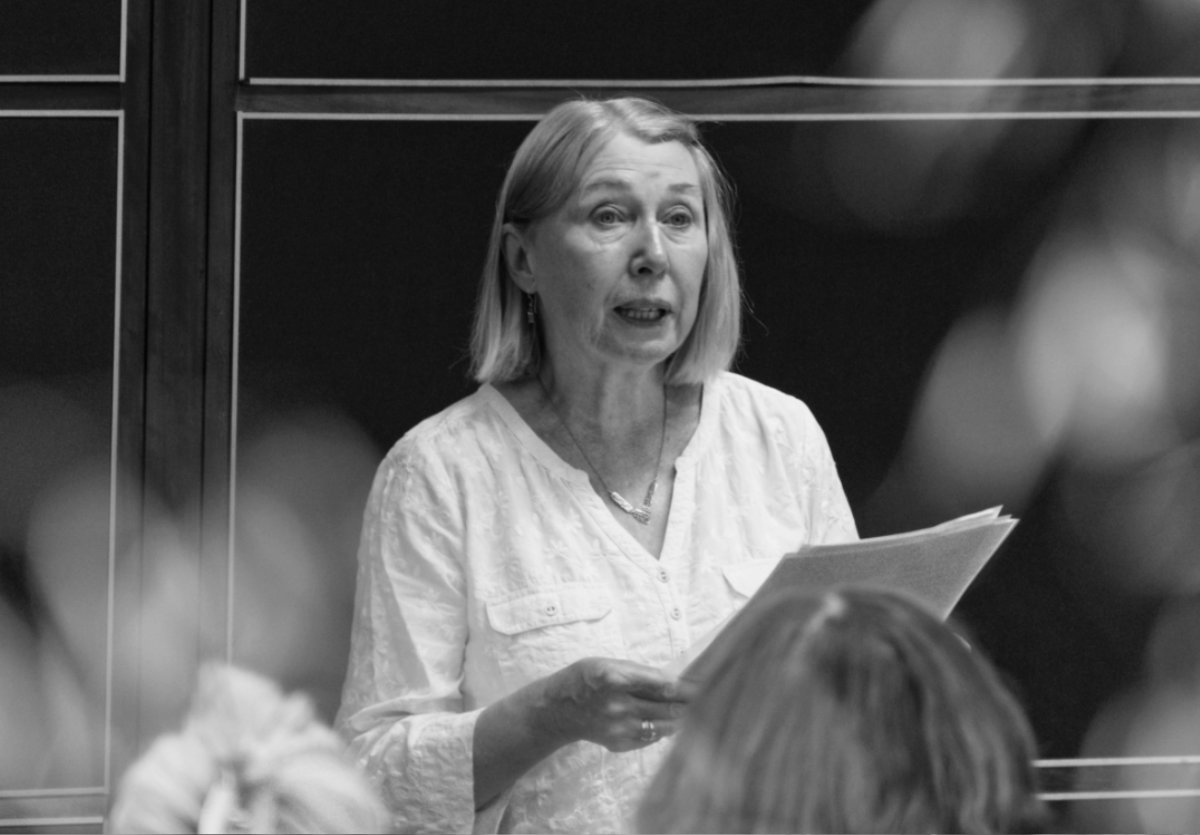
A few photos from the batch, at last Friday's summer reading by Stroud Poets at Museum in the Park. A good show, with new pamphlets out from the Yew Tree Press, a week's work under the belt of the Dialect Writers and Alun Hughes reading from Down the Heavens. 


f anyone performing hasn't received photos/confirmation they're available, do get in touch - email on the me me page.

Wednesday, 29 June 2022

Tradition

On poetry, TS Eliot explains understanding evolves from the physical effectiveness of any given poem, how it works on his senses, his emotions.  It is from this point, as one gathers or weighs the components of a piece, the work of intellect starts. And it is a relief to be reading Eliot again, a confirmation, spelling out what he instinctively knows makes a poem.

His discussion of plays shines less. Putting the play as a whole over any particular character Eliot makes the refreshing case that Hamlet is a failure.   Enjoyment of the play might trump this view, but I accept his conclusion that with Hamlet, frustrated in matching his own intense feelings to his mother’s passive self, Shakespeare tackled a problem which proved too much for him.  The whole how or why of it we can never know… we assume it to be an experience which exceeded the facts. To know why Hamlet was made to tackle problems beyond him we should have to understand things which Shakespeare did not understand himself.

Less than madness, more than feigned: with adolescence and psychology turned over and dismissed: the levity of Hamlet, his repetition of phrase, his puns, are not part of a deliberate plan to dissimulation, but a form of emotional relief. In the character it is the buffoonery of an emotion which can find no outlet in action: in the dramatist it is the buffoonery of an emotion which he cannot express in art. And as every wit is strained to align the world with his own experience, Hamlet indeed seems Eliot’s artist, who intensifies the world to his emotions. 

Isn’t it in that that the prince precisely is, or proves again to be, the mirror of the age?  Eliot is right to point out Hamlet is not so young as to unable to keep his emotions unchecked, so disturbed as to have his ghosts and uncertainties separate him entirely from that upset world where the play begins.
And I remember there is that renaissance marque of Hamlet and Yorick’s skull, even by the Elizabethan age we still had a foot entrenched in the middle ages, close to death in life and etc.

I am content the anguish, the separation, this unchecked indulgence and lack of conclusion in Shakespeare’s drawn-up struggle of wits - to the distress of family and court - is the play itself.  It comes to mind Arthur Miller, in his autobiography Timebends, records a visit by Robert Lowell and when the poet made some pronouncement on the determined rules of a playwright, adding that as Eliot said so it, must be true.  Perhaps unspoken at the time, Miller’s reaction was:  I’ll be the judge of that.

Lowell, Miller and Gertrude

.

Well, I am putting aside Augustine – more patience required – Wallace Stevens –  same – Death of the Poets, by an English pair eminently sortable into type themselves – no – pleased to be back on the trail of the aesthetic and purpose of the poet.

From Tradition and the Individual Talent

“…There are many people who appreciate the expression of sincere emotion in verse, and there is a smaller number of people who can appreciate technical excellence. But very few know when there is an expression of significant emotion, emotion which has its life in the poem and not in the history of the poet.  The emotion of art is impersonal. And the poet cannot reach this impersonality without surrendering himself wholly to the work to be done.  And he is not likely to know what is to be done unless he lives in what is not merely the present, but the present moment of the past, unless he is conscious, not of what is dead, but of what is already living.”

Monday, 20 June 2022

Stroud Poets

A couple more videos conjured up this week with Stroud poets, Jacqui Stearn and Caroline Shaw.  The films were fun to make, and it is always entertaining to spend time with poets. And room for improvement – keep your hand in with the bloody gimbal is another note to self – but always something comes out of it.  Caroline’s engaging poem below.


Tuesday, 31 May 2022

The Metal Exchange


I’m just into David Cooke’s new collection, The Metal Exchange, Littoral Press, easing into that familiar certainty of rhythm, the even measure of his verse.  A forward to Neruda sets the tone.  Then into the metals, Silverado: Minted that ends so well, arm’s length appreciations of Brass and Gold, the rare earths.  At the finish of Lead, pitch perfect, “dependable and grey” I put down the book a minute:

We’ve both turned out this season in Littoral’s blue livery and David’s sent me a copy of his book to mark the occasion.  Thank you!  I would have sent him a copy of Smudge but I know, as editor of HighWindow and a prolific reader the last thing he needs is yet another book in passing. 

A recommendation though, David, just in case you haven’t read it, Primo Levi’s, The Periodic Table, is a superb collection of stories that open up a lovely, lively vein of elements, of base and precious metals. If Pablo hasn’t passed that way, you have, and are free to enjoy what else has been gleaned, reflecting on metals singing underfoot.


Friday, 22 April 2022

Subverse Recital

Zoe Brooks and Clare Pollard in Stroud on Wednesday, between them made an engaging evening’s recital.  Host Adam was right, they complimented each other. 

Two generations of women: Zoe with a conjuring up of the works of hands, and the vivid, alarming mood swings of Punch, Clare with an incisive creativity sharing the love and hardship of a woman’s lot.  Was it her blood in the snow, or Zoe’s? I can’t remember.

Plumped down on the comfy seat before the stage – a step for the performers would have been a kindness – I was well-placed to enjoy the presentation, and well-reminded of the purpose of a poetry recital, it's  sharing of thought and perspective.  

Too much apart, I am looking forward to seeing more poetry in action.  As SubVerse was so refreshing I’d say good poetry in particular - the evening swam by - but any like event is usually time well spent, like an hour in a gallery. But what a good crowd the poets are.

Wednesday, 13 April 2022

LightBox, Woking 26 May

 A second review for Smudge in Write Out Loud an amiable introduction to the verse, and, as a follow up, invited along by Greg Freeman and WOL company to join their monthly session at the Lightbox, Woking. Thursday 26 May. Gargling and voice exercises resume.

I watched the Ian McKellen one man show on the box last night, on the downside, that daft old NT inflexion crept in to the Shakespeare, here and there - perhaps a memory key, the show was long - but much of the McKellen sheer quality, and most enjoyable his recital of Hopkins' Leaden Echo and Golden Echo. Good grief, to think how i whine and stumble over my few lines of verse. Speak Oot Man, speak oot!

Wednesday, 16 March 2022

Try imagining a place

 In an upcoming review of SMUDGE it’s put, Louis MacNeice’s poet had better deal with the incorrigible plurality of life, but James won’t have anything to do with it.  Maybe not.  I find the duality in all things, comparison in opposites, but my aim, should I focus on such a thing, perhaps is more the unity of the moment. “…James is the poet of the moment.”   

We must interpret meanings in their own light.  Blake’s The Sick Rose, has strong religious or psychological overtones. Dylan might be singing of Christian promise in Shelter from the storm, Or is it simply a love song?  Is it in the heart, or mind? In the distance between those poles: room to manoeuvre. 

If the opposite of time is eternity, there’s unity, even purpose in a world we are part of and cannot long ignore.

O Rose thou art sick. 
The invisible worm, 
That flies in the night 
In the howling storm: 

Has found out thy bed
Of crimson joy:
And his dark secret love
Does thy life destroy.